Paris Sewers
Les MisérablesThe Paris Sewers are the hidden route through which Jean Valjean removes the unconscious Marius Pontmercy from the barricade and carries him toward safety. In this episode, the underground passage is more than a means of escape: it reverses the conditions of the scene, exchanging open combat for darkness and silence, while concealing the identity of the rescuer from the person he saves.
Discovery beneath the barricade
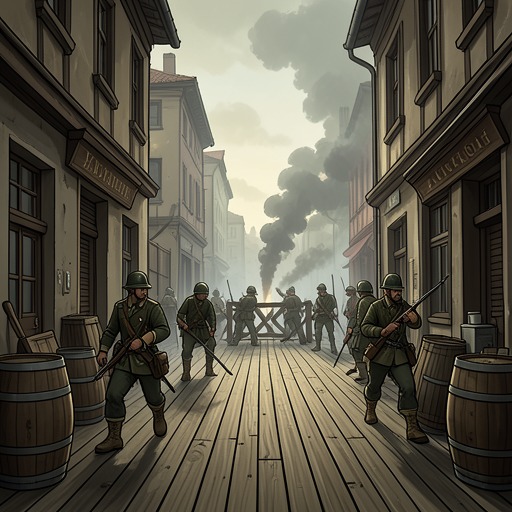
At the barricade, the immediate danger is not abstract. The fighting is concentrated at the cabaret door, but a soldier who turned the building or attacked it from the flank could end the defenders’ resistance. Jean Valjean looks from the house to the barricade and then down at the ground, forced to find another way out while Marius lies unconscious beside him. In that urgent search, a low iron grid appears beneath displaced paving stones, close to a small barricade watched from outside.
The opening is specific and precarious: the grid is roughly two feet square, its stone setting has been torn up, and its heavy transverse bars cover a dark shaft. Jean Valjean recognizes the possibility of escape through his past experience of flight. He clears the stones, lifts the grid, and lowers himself into the opening with Marius on his back. The route is not a broad, prepared passage but a narrow descent of about three metres, made possible by the loosened cover and by the paving stones collapsing back over it.
From combat to concealment
The movement takes only a few minutes. Jean Valjean carries Marius down the shaft, using his elbows and knees, and reaches a paved surface below ground. He is not alone: Marius remains limp and unresponsive, and Jean Valjean cannot yet tell whether the wounded man is alive or dead. The physical rescue therefore does not immediately settle its most urgent question. The danger of capture gives way to the uncertainty of whether the person carried away can survive.
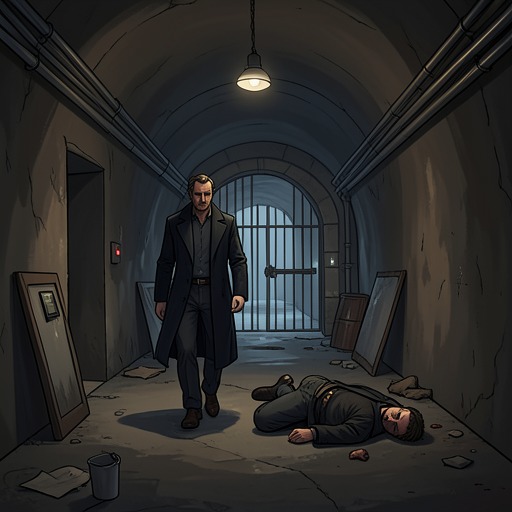
The passage produces a sharp change in the scene’s scale and atmosphere. Jean Valjean has passed from a street in the middle of Paris into a long subterranean corridor. The narrative marks the change through a sequence of oppositions: full daylight becomes complete darkness, noon becomes midnight, tumult becomes silence, and extreme peril becomes apparent security. The city remains above him, but for the moment its noise and violence have been shut out by a lid of iron and falling stones.
That abrupt shelter recalls an earlier transition in Jean Valjean’s life: his passage from the street into the convent while carrying Cosette. The resemblance is clear, but the person he now bears is different. Instead of Cosette, he carries Marius. The repeated pattern makes the sewer a threshold between danger and refuge, while the changed burden gives the repetition a new human and emotional stake.
The city’s hidden route
The episode presents the sewers as a place where someone can disappear within Paris without leaving the city’s physical bounds. Jean Valjean has emerged from the violence of the street into a space described as a kind of tomb, yet that apparent burial contains the possibility of life. The descent is sudden enough to feel like a trap opening beneath him, but it functions as deliverance: the cover that hides the shaft also cuts the fugitives off from the danger immediately above.
This reversal is especially striking because safety arrives through an obscure opening found by chance in the middle of an urgent search. The route is neither an announced plan nor a visible road away from the fighting. It is exposed only when Jean Valjean looks at the ground in extremity. The contrast between the watched barricade above and the concealed corridor below gives the rescue its shape: public violence has filled the street, while the means of escape lies underfoot.
Marius’s incomplete knowledge
Marius later remembers almost nothing of the journey. His last fragment of awareness is an energetic hand seizing him from behind as he falls backward at the barricade; after that, his recollection ends until he recovers at M. Gillenormand’s home. He cannot explain how he came to be taken from the fighting and found by a police agent on the bank of the Seine near the Pont des Invalides.
He works out that whoever carried him must have taken him from the Les Halles district to the Champs-Élysées by way of the sewers. The route becomes intelligible to him, but the person who used it remains unknown. His search for that rescuer turns the hidden passage into an unresolved connection between two men: Jean Valjean’s act has preserved Marius, while Marius knows only that an extraordinary act of devotion took place. The sewers thus conceal not merely a journey but, for a time, the identity and meaning of the person who made it possible.